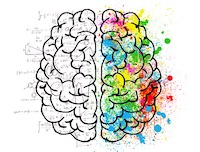

Brain scientist Dr. Jill Bolte Taylor talks about the 90 second rule for emotions. She describes the chemical release of an emotion only lasting 90 seconds. Effectively that means that if you’re feeling sad or angry, you’re only feeling that for 90 seconds at a time.
I’m sure you’re thinking “but I can be angry or sad for hours or sometimes days at a time”, and what’s happening in those cases is that you’re continually retriggering those same emotions over and over again. It’s not the same chemical release over a long time, it’s a continual retriggering of those chemical releases.
What does that mean for practical purposes? It means that if we can interrupt the patterns that we’re following, we’ve got at most another 90 seconds to put up with those negative emotions before we start to feel better.
Why do I only mention negative emotions? Because I’m assuming that you have no interest in interrupting happy emotions. Let’s let the happy ones continue to run.
What could that interrupt look like? It could be as simple as the phone ringing and grabbing your attention. It could be movement to shift your state, particularly movement into a different environment such as walking outside. Just standing up and shaking your body can be a powerful interrupt.
For even more powerful interrupts, almost any of the techniques that I show in the Anxiety Reset will help here. I teach them in the context of anxiety but they’re powerful interruptions and will work in other situations too.
When you’re feeling those negative emotions for long periods of time, you’re just running habitual patterns in your brain, and those patterns can be interrupted.
What’s even better is that the more often we interrupt those patterns, the less we’ll run them. This is just another aspect of Hebb’s law: “Neurons that fire together wire together”. The more we run the same patterns, the stronger they’ll become. The more we interrupt them, the weaker they become.
A related trick is to label emotions when we notice them. The simple act of saying to ourselves “I am angry” or “I am sad” will weaken that effect on us. This technique is called “affect labeling” and is surprisingly effective.
“Behavioral and neuroimaging studies suggest that merely putting feelings into words can serve as a regulatory strategy”
— Levy-Gigi, E., & Shamay-Tsoory, S. (2022). Affect labeling: The role of timing and intensity. PloS one, 17(12), e0279303.
The key point here is that if we’re regularly feeling emotions that we don’t want to feel, there are ways to lessen that, and many of them are quite simple to do.
Standard disclaimer: There are no approaches that work for all of the people, all of the time. If what you’re trying isn’t working for you, perhaps you should seek out a professional to find approaches that will work in your context.