
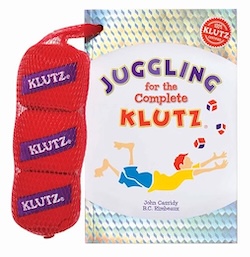
When I was a teenager, I read a book called Juggling for the Complete Klutz, which seemed just perfect for me. It came with three bean bag balls, and instructions on how to use them.
It wasn’t a large book, and I quickly read through all of it. Yet, while I now “knew” how to do it, I still couldn’t juggle.
I tried the things I’d read in the book and immediately dropped the balls. I picked them up again and this time I managed a few passes before dropping the ball. Over and over and over again, I picked up the balls and tried again. The more I practiced, the more the knowledge of juggling started to make sense. It became what we often call “muscle memory” but is really just unconscious programming. Through this constant practice, I was able to absorb the knowledge of juggling.
This is the essence of Tacit Knowledge; things that have to be experienced, rather than just read.
If I could have absorbed the lessons just from reading the book then this would have been Explicit Knowledge, but juggling isn’t that.
Why is important to distinguish between these? Because it takes very different approaches to learn tacit knowledge than it does explicit. All too often we think that any problem can be addressed by just watching a video or reading an article, and that’s not true. Some things need to be experienced to be understood.
Almost everything that gets written about here is explicit knowledge. While I can certainly write an article to tell you about the mechanics of juggling, until you actually do it, you won’t have learned what you need to know.
A more concrete example for my audience might be Clean Language. I’ve certainly written about that before and I’ve covered the dozen phrases and some of the mechanics, but unless you’ve actually used Clean Language to solve real problems, you haven’t really learned it. Clean is a tool for the client to find their own answers, not for us to find those answers for them.
At the end of a Clean Language session, we often don’t know what solution the client came up with, and sometimes don’t even know what the original problem was. We gave the client some structure, and they found the answers themselves. Try learning that from a book, without significant practice.
This brings us to coaching and training. There’s a difference between what I can write in an article here and what I can do with people who are getting active coaching or training. The latter is far more comprehensive, both in range and impact.
I’m glad that people read the articles I write. The next step is to experience some of that tacit knowledge, and for that we have to actually interact. I make some time available every week and you can book some of that here. Let’s talk.